

Many adult pianists interested in circle of fifths piano improvisation want to improvise but end up guessing notes or relying on memorised patterns. The problem is rarely lack of ability. It is usually a missing understanding of how harmony actually moves in music.
A very practical tool.
The Circle of Fifths is one of the most practical tools for solving this. It shows how keys and chords are connected and explains why certain progressions sound natural. When you understand this movement, improvisation stops feeling random and starts feeling guided.
This article explains what the Circle of Fifths is, how pianists use it in real playing situations, and how it helps you improvise and play your favourite music by ear without depending on sheet music.
What is the Circle of Fifths in simple terms?
The Circle of Fifths is a visual way of organising all twelve musical keys based on their harmonic relationship. Each key sits a perfect fifth away from the next, creating a circle that shows how closely related different keys are.
Keys that sit next to each other on the circle share most of the same notes. This is why moving between them sounds smooth and logical, even if you are not consciously thinking about theory while playing.
For a neutral reference diagram, the Circle of Fifths is also clearly explained on Wikipedia.https://en.wikipedia.org/wiki/Circle_of_fifths
Why the Circle of Fifths matters for adult piano learners
Adult learners often want to understand what they are playing instead of just copying shapes. The Circle of Fifths provides that overview. It explains why music behaves the way it does instead of presenting harmony as a collection of unrelated rules.
Once this logic is clear, learning new songs becomes faster, transposing feels manageable, and improvisation stops feeling like a risky guessing game.
How the Circle of Fifths organises keys and chords logically
Each step around the circle moves by a perfect fifth. Clockwise movement adds sharps, counter-clockwise adds flats. This organisation mirrors how harmony naturally progresses in most styles of music.
Because chords are built from keys, the Circle of Fifths also shows how chord progressions are connected. This is why it becomes such a powerful tool when improvising.
How does the Circle of Fifths help with piano improvisation in practice?
Improvisation is not about finding clever notes. It is about knowing where you are harmonically and where you can go next. The Circle of Fifths provides that orientation.
Instead of freezing when a chord changes, you begin to recognise familiar movement patterns. This gives you time to focus on phrasing, rhythm, and expression rather than survival.
Why circle of fifths piano improvisation is about navigation, not talent
Good improvisers are not guessing better than everyone else. They are navigating harmony with intention. The Circle of Fifths gives you a reliable sense of direction, even when playing spontaneously.
This is especially helpful for adult learners who want consistency and understanding rather than trial and error.
How the Circle of Fifths shows where harmony wants to move
Most functional harmony moves clockwise around the Circle of Fifths. This motion creates forward momentum and resolution that your ear naturally expects.
When you follow this movement while improvising, your playing sounds structured and musical even with very simple note choices.
Can the Circle of Fifths help me play piano by ear?
Yes. Playing by ear improves when you recognise patterns rather than individual notes. The Circle of Fifths helps you predict what is likely to come next instead of reacting too late.
This makes it easier to join in, accompany singers, or figure out songs without written music.
How recognising chord movement improves playing by ear
When you recognise common harmonic movement, you stop listening for single notes and start listening for direction. This dramatically speeds up learning by ear.
Your hands respond faster because the options are reduced. You are no longer searching the entire keyboard.
Why nearby keys sound right even without sheet music
Keys that sit next to each other on the Circle of Fifths share many notes. That is why modulating or improvising between them sounds natural.
Understanding this allows you to move between keys confidently when improvising, even if you cannot name them instantly.
How do I actually use the Circle of Fifths at the piano?
The Circle of Fifths is learned best at the keyboard, not on paper. Simple, controlled exercises combined with basic scale practice are very effective in building up important muscle memory – far more effective than just academic memorisation.
The goal is to feel harmonic movement physically and aurally.
Why major scale practice makes the Circle of Fifths easier to understand
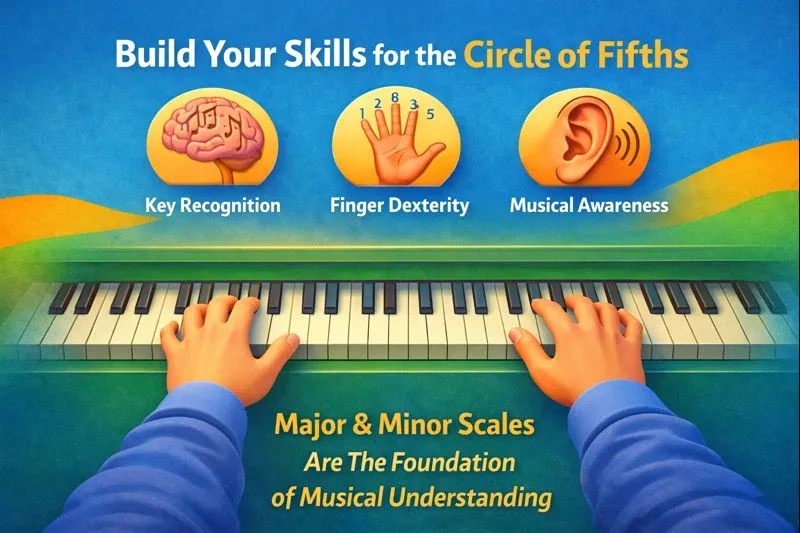
For many adult students, basic major scale practice is an important precursor to using the Circle of Fifths effectively. Without familiarity with major scales, theoretical explanations can feel abstract and difficult to apply at the keyboard. Practising major scales builds key awareness, finger confidence, and note recognition, which makes the Circle of Fifths far easier to understand and use in real playing situations.
You do not need perfect technique in all twelve keys, but working methodically through major scales gives the Circle of Fifths practical meaning instead of remaining a diagram on paper.
A left-hand exercise to feel harmonic movement
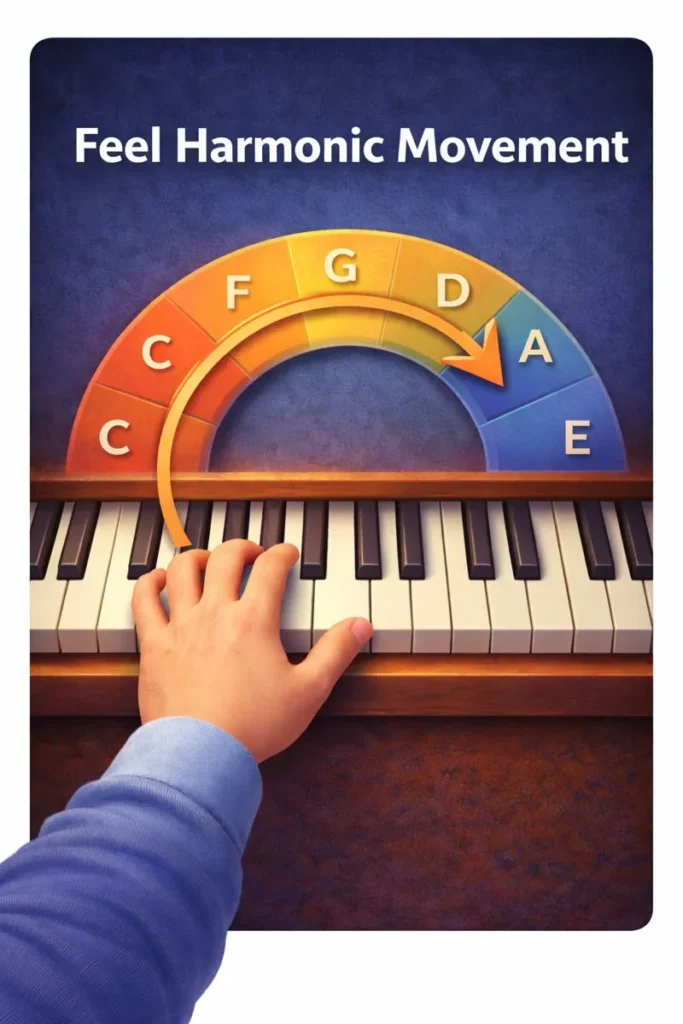
Start by playing a simple major chord in your left hand, using a comfortable root position. For example, begin with a C major chord. Hold the chord for a few seconds and listen carefully to its character rather than rushing ahead. Then move clockwise around the Circle of Fifths to the next key and play the next major chord, in this case F major. Continue this process one chord at a time, moving slowly through the circle.
The goal of this exercise is not speed or technical difficulty. It is to experience how harmony naturally flows from one chord to the next. As you move through the Circle of Fifths, notice how each chord feels connected to the previous one, even though the notes are changing. This is the sound of functional harmony in action.
Play each chord evenly, with a relaxed hand, and give your ear enough time to register the change before moving on. If possible, say the chord name out loud as you play it. This reinforces key awareness and strengthens the mental link between what you hear and what you play.
Practised regularly, this simple left-hand exercise builds an instinctive sense of harmonic direction. Over time, your hand will begin to anticipate where harmony wants to go next, which is exactly the skill needed for confident improvisation and playing by ear.
A right-hand improvisation exercise using one scale
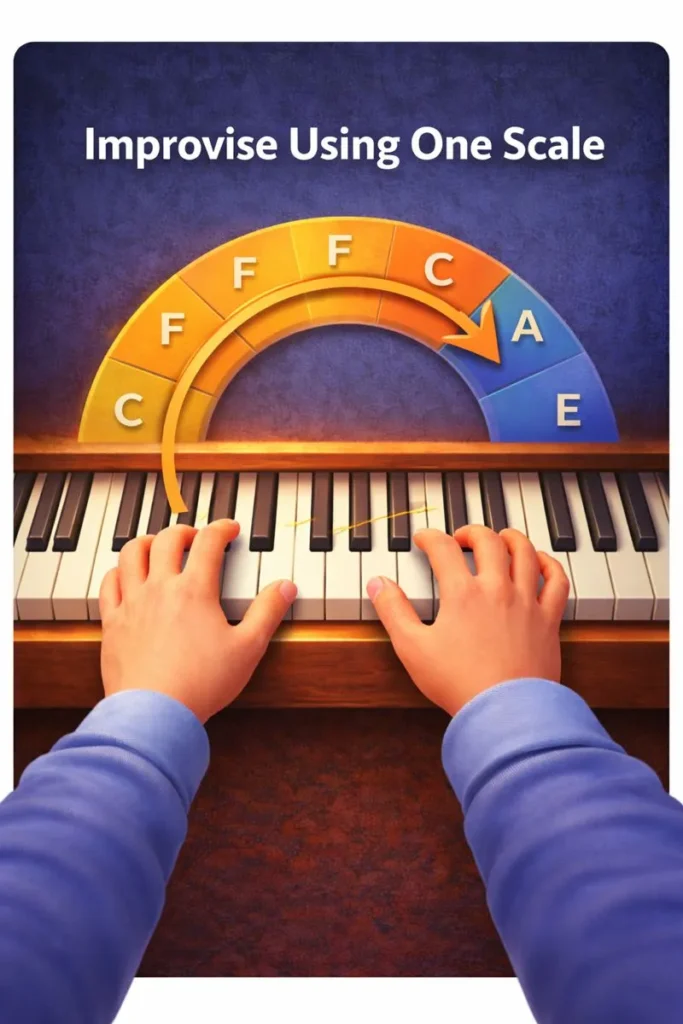
Begin by holding a simple chord in your left hand, for example a C major chord. Keep the left hand steady and relaxed, and let it act as a harmonic foundation. In your right hand, improvise freely using only the notes of the C major scale. Do not worry about playing fast or sounding impressive. Focus on creating short, simple phrases and listen carefully to how each note relates to the chord underneath.
After a short while, change the left-hand chord to the next key, following the Circle of Fifths. For example, move from C major to F major. When the chord changes, switch your right hand to the matching scale for that key. Take a moment before playing to locate the new scale, then continue improvising with the same calm, exploratory approach.
The purpose of this exercise is to train adaptability rather than memorisation. You are learning to respond to harmonic movement in real time, adjusting your melodic choices as the harmony shifts. This mirrors what happens in real music, where chords move underneath a melody and the player must stay oriented.
Keep the improvisation simple and controlled. Use repeated notes, small intervals, and clear endings to phrases. Over time, this exercise builds confidence in switching tonal centres and helps your ear recognise which notes feel stable as harmony changes. This skill is essential for improvisation that sounds intentional rather than random.
Do I need to memorise the Circle of Fifths to improvise?
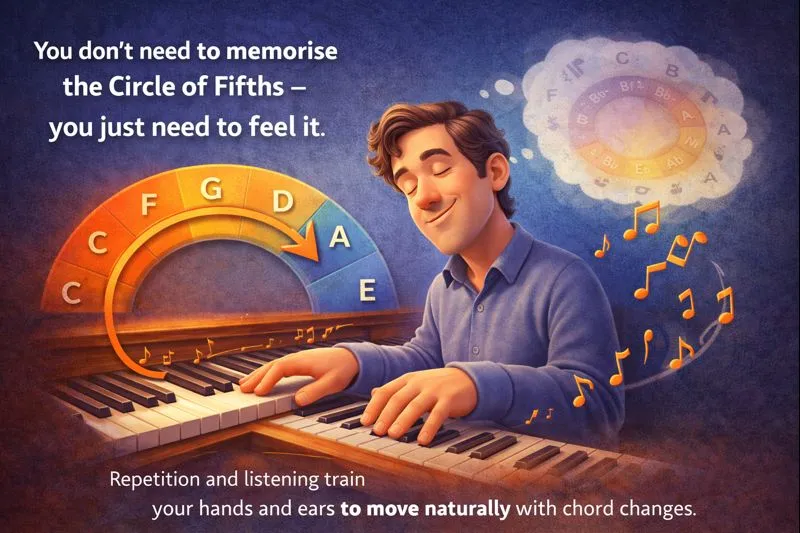
No. Memorisation alone does not create musical results. Physical repetition and listening do. You want to build up muscle memory, so that you can forget about the theory when performing.
The Circle of Fifths becomes useful when it is felt, not recited.
Why memorisation is not required
Many strong improvisers cannot recite the Circle of Fifths verbally, but they recognise its movement instantly at the keyboard.
Your hands and ears learn faster than your memory.
How repetition at the keyboard builds instinct
Repeating simple harmonic movements daily builds muscle memory and listening skills at the same time.
Over time, you stop thinking about the Circle of Fifths and simply move with it.
Is the Circle of Fifths used in real songs I already know?
Yes. The Circle of Fifths underpins harmony in pop, jazz, film music, soul, and many other styles.
Once you recognise it, you start hearing the same movements everywhere.
How pop, jazz, film, and soul music follow Circle of Fifths motion
Common chord progressions often move by fifths because this creates strong resolution and emotional clarity.
This is why learning the Circle of Fifths has immediate practical value.
Why this matters when improvising your favourite music
When you recognise these patterns, improvising over familiar songs becomes easier and more confident.
You are no longer reacting blindly to changes.
How does the Circle of Fifths Piano Improvisation connect to learning improvisation properly?
The Circle of Fifths is not the end goal. It is the framework that supports more advanced improvisation tools.
Once this foundation is solid, everything else makes more sense.
How it leads directly to 2-5-1 chord progression
The most important progression in modern music, the 2-5-1, follows the Circle of Fifths exactly.
Understanding the circle makes this progression feel logical rather than theoretical.
Why this is the foundation for structured improvisation
Improvisation improves when you reduce uncertainty. The circle of fifths piano improvisation exercises will guide your choices in a helpful way.
Instead of guessing, you navigate. That is the real skill behind confident piano improvisation.
If you want to apply circle of fifths piano improvisation in a structured way, this approach is taught step by step in my adult piano lessons in Marbella.
Circle of Fifths Piano Improvisation – Related Links:
Blog Article: How to find the best piano teacher for adults in Marbella