

What adult piano students learn during their first year is often different from what they expect.
There is more to learn than playing a collection of pieces. Reading, rhythm, technique, scales, chords, harmony and listening all have to develop. For students interested in pop or jazz, accompaniment and improvisation can become part of the lessons as well.
I see this regularly with adult beginners. At first, they are often surprised by how much there is to learn. As the different skills start to connect, the piano becomes easier to understand. Scales help with chords, chords help with accompaniment, and better rhythm makes pieces more secure.
The student gradually starts to see how music works.
What I Teach During the First Year
I don’t use a fixed first-year curriculum for every adult student. Lessons depend on the student’s progress, musical interests and previous experience.
A typical lesson might include scales, broken chords, a classical minuet, an accessible ABRSM jazz piece and a song chosen by the student. I also teach the theory that is relevant to what we are playing, particularly scales, keys and chord building.
If we are practising a scale, we can look at the chords built from that scale. If a piece contains a difficult rhythm, we can work on the rhythm separately. A pop song can introduce chord symbols and accompaniment. Jazz can introduce different voicings and improvisation.
The balance depends on the student and what needs attention at that point.
Lynne: From Complete Beginner to Approaching Grade 2
Lynne is one of my adult students. She started piano from scratch six months ago.
She can now play eight major scales with both hands and broken chords in eight keys. She plays major chords, seventh chords and suspended chords and has started working with stride piano, using bass notes and chords.
Her repertoire covers classical, jazz and pop.
She has worked on ABRSM Grade 1 classical minuets and can accompany pop songs such as “Make You Feel My Love” by reading the chord symbols. She also plays the jazz standard “Summertime”, combining the melody with more complex chords.
Her ABRSM jazz work includes the Grade 1 piece “He Is Sadly Melting”, including improvisation.
I also want the style to sound right. Classical pieces, jazz standards and pop accompaniment need different techniques and a different musical approach. Learning those differences is part of the lesson.
After six months, Lynne is approaching ABRSM Grade 2 standard in both classical and jazz. Outside the graded material, she is becoming a solid accompanist.
Her ear has developed too. She can match piano notes with her voice and sing the scales she is learning.
For someone who started from scratch six months ago, the result is very encouraging. She is developing technique, reading, rhythm, chords, accompaniment, improvisation and ear training at the same time.
Why I Use Backing Tracks in Piano Lessons
Backing tracks have become an important part of my teaching because they develop something that is difficult to practise when playing alone: keeping the music going.
When practising alone, a student can hesitate, slow down or stop when something goes wrong. With a backing track, the band carries on.
The student has to listen, count, come in at the right place and keep time. If a mistake happens, they have to recover and continue.
This gets much closer to the experience of playing with other musicians. It also teaches the student that playing the correct notes is only part of a performance. Timing and listening matter just as much.
I have found backing tracks particularly effective for speeding up this part of a student’s development. Students become more aware of the pulse and learn to keep going instead of treating every mistake as a reason to stop.
My Ninja Scale Technique
I use a particular approach to scale practice that I call the Ninja Scale technique.
The student plays a scale over two or more octaves and adds notes at each end to compensate for the timing of the turn. This allows the scale to continue as a loop instead of stopping and starting again after every repetition.
The continuous movement saves practice time and works on dexterity and timing. There is no pause to reset the scale between repetitions.
Once the scale is secure, we can use the same knowledge elsewhere. We can build chords from it, look at the key, use the notes for improvisation or identify the same material in a piece of music.
Chords, Accompaniment and Improvisation
I introduce chords quite early with students who are interested in pop, rock, blues or jazz.
We can start with major chords and move into seventh chords, suspended chords, inversions, broken chords and different accompaniment patterns as the student’s playing develops.
Being able to read chord symbols is particularly useful. Lynne, for example, can use the chord symbols in “Make You Feel My Love” to accompany the song. That requires a different approach from reading every note from a classical score.
“Summertime” takes the chord work further. The student has to deal with jazz harmony while playing the melody and keeping the character of the music.
Improvisation can develop alongside this work. Scales provide the notes and the chords establish the harmony. We can then listen to how those notes work against the chords and start creating simple musical phrases.
Reading, Rhythm and Music Theory
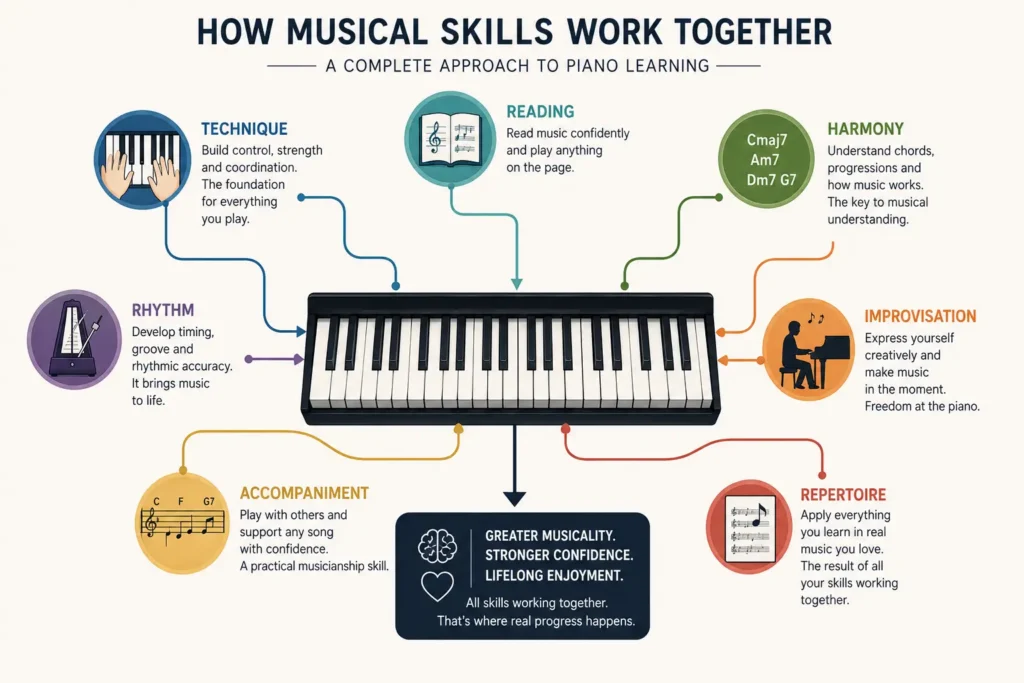
A complete beginner may initially have to identify individual notes and work out where they are on the keyboard. With experience, familiar shapes begin to appear. Intervals, chords and rhythmic patterns become easier to recognise.
Rhythm needs its own attention too. If a student repeatedly has trouble with a rhythm in a piece, I will often take it out of the music and work on it separately. When we put everything back together, a backing track can be useful because the student has to maintain the pulse.
I teach theory in the same practical way. If we are learning a scale, it makes sense to discuss the key and the chords that can be built from it. When chord symbols appear in a song, we can look at how those chords are constructed.
The theory has an immediate use at the piano.
What Progress Can Look Like After the First Year
There isn’t one standard that every adult student should reach after twelve months.
Some students practise more than others and some have previous musical experience. One student may be interested mainly in classical piano, while another wants to play pop songs, accompany a singer or learn jazz and improvisation.
After a year, I would expect to see greater independence across several areas. The student should be reading more comfortably, keeping better time and becoming more secure with scales, broken chords and chord construction. Depending on what we have studied, they may also be able to accompany from chord symbols, recognise pitches by ear and recover from mistakes without stopping the performance.
I also look at how much the student can work out independently. Recognising something from an earlier piece, understanding a chord symbol or solving a fingering problem without immediately asking for help are all signs that the work is becoming established.
Adult beginners are often surprised by the amount involved in learning piano. With experience, scales, chords, reading, rhythm and technique become more familiar, and the student has more tools available when learning new music.
Lynne’s first six months are a good example. She started from scratch and is now approaching Grade 2 material, accompanying from chord symbols, improvising, playing classical and jazz repertoire, working with backing tracks and developing her ear.
That gives a much better picture of her progress than the number of pieces she has completed.
Frequently Asked Questions
How long does it take adults to learn piano?
There is no fixed timetable. A complete beginner can start playing useful material relatively quickly, but progress depends on practice, consistency, previous musical experience and what the student wants to achieve.
What should adult piano students practise?
My adult students normally work on a combination of repertoire, scales, broken chords, reading, rhythm and relevant music theory. Depending on the student’s interests, practice can also include chord-symbol reading, accompaniment, improvisation, ear training and playing with backing tracks.
Are scales important for adult piano students?
Yes. I use scales to develop technique, dexterity, timing and knowledge of the keyboard. They are also useful for understanding keys and chords and provide material for improvisation.
Can adults learn piano without reading music?
Yes. Playing from chord symbols, accompanying songs and playing by ear are all useful musical skills. I also teach reading because it gives students access to written repertoire and another way of understanding music.
Can adult beginners learn improvisation?
Yes. Improvisation can be introduced through scales, chords and rhythm. I regularly introduce it with adult beginners as part of their practical piano and jazz work.
Why do you use backing tracks in piano lessons?
Backing tracks require students to maintain tempo and keep playing while the other musical parts continue around them. I use them to develop timing, listening and performance skills and to give students some of the experience of playing with a band.
Do you offer adult piano lessons in Marbella, San Pedro and Estepona?
Yes. Adult piano lessons are available in my studio between San Pedro and Estepona, online via Zoom, and as limited home visits in Marbella, San Pedro, Guadalmina and surrounding areas. See my piano lesson formats for more information.
Interested in Adult Piano Lessons?
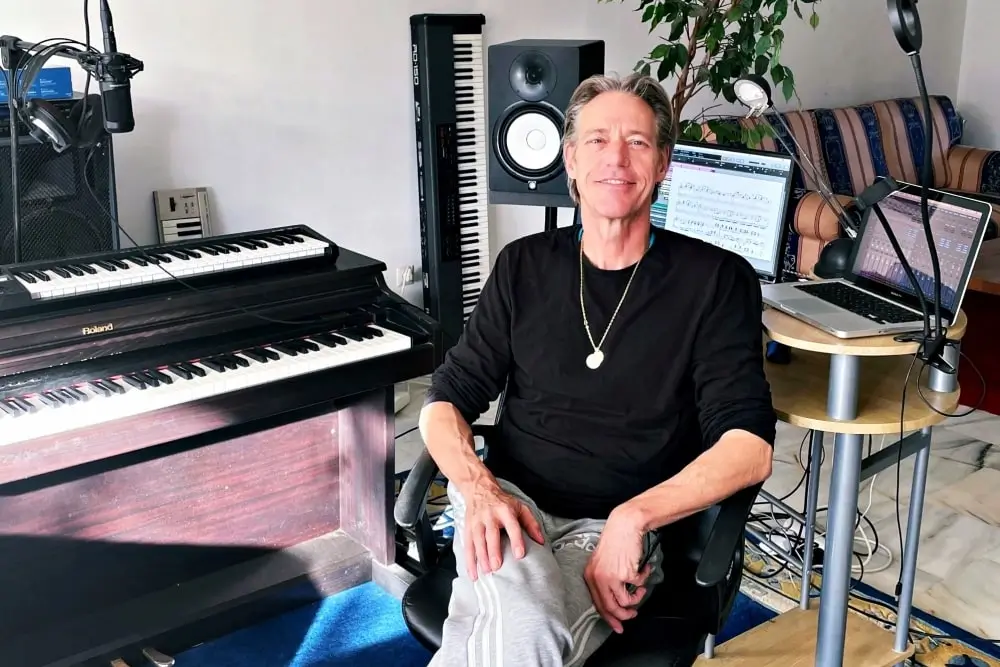
If you’re considering piano lessons, you can learn more about my adult piano lessons in Marbella, San Pedro and Estepona.
Whether you’re starting from scratch, returning to the piano or already have playing experience, I structure lessons around your level, musical interests and goals.